
About Us
Our Story
Urvara Krsi is an MSME startup company incorporated in December 2019, currently engaged in two business verticals: Forest Plantations and Dehydrated Fruits and Vegetables through its brand name Urvidha.
Since its inception, Urvara Krsi has been promoting tree plantations on farmer lands through Farm Forestry and Agroforestry models across various states in India, including Maharashtra, Odisha, and Chhattisgarh. Afforestation enables climate mitigation through carbon sequestration, increases soil productivity, prevents soil erosion, and enhances groundwater recharge. Urvara advocates sustainable practices in agriculture and forestry to promote resource efficiency and reduce environmental impact.
Over the past five years, we have collaborated closely with over 10,000 farmers, many of whom are from tribal communities with low-productive, degraded rain-fed lands, to promote tree plantation for higher productivity and income. The promotion of large-scale plantations and skill-building initiatives by Urvara Krsi has created rural employment opportunities, especially for women in our nurseries and landless labour in various activities during the plantation cycle, such as planting, weeding, and harvesting. These job opportunities help reduce migration from small remote villages.
Urvara Krsi operates and manages tree clonal plant production nurseries with a capacity to produce 10 million clonal plants per annum. Our nurseries produce true-to-type superior quality plants for supply to farmers and other customers. Research and development to introduce new clones periodically is a significant area of focus and investment for our company, as evidenced by the release of new site-specific clones by Urvara Krsi.
In early 2020, the acquisition of Avantha Agri Tech Limited brought the company’s forestry-related business interests under our fold, along with a considerable network, resources, skillsets, and uniquely qualified experience of its talent pool.
In 2023, Urvara Krsi diversified into the manufacturing of dried fruits and vegetables, marking the next chapter in Urvara Krsi’s commitment to sustainable agriculture, environmentally friendly farming practices, and strong farmer partnerships. These products are now available for sale in both B2B and B2C markets.
In October 2024, our brand Urvidha launched on Amazon.
Vision
We aim to be a leading Tree Clonal Plant Production, Research & Distribution Centre, providing high-yielding clonal plants with sustainable practices.
We strive to be a trusted supplier of top-quality tree clonal plant germplasm.
Our goal is to collaborate with farming communities across India to promote Farm Forestry on degraded, low productive rain-fed farmlands and Agroforestry with crops, enhancing soil health, productivity, green cover, and carbon sequestration for climate mitigation and environmental benefits.
Mission
Urvara Krsi focuses on sustainability by integrating quality germplasm availability and raising productive forest plantations on less-productive farmlands with farmers. We aim to promote sustainable, environmentally friendly practices in all our operations.
We ensure higher incomes for stakeholders and investors, and inclusive growth for rural communities, thus laying the foundation for successful long-term partnerships.
Our Values
Transparency
Accountability
Sustainable Focus
Inclusive Growth
Quality & Reliability
Eco-consciousness
Policies
UKPL has Board-verified policies on Code of Conduct (COC) and Prevention of Sexual Harassment (POSH).
These policies define acceptable behaviour, outline procedures for reporting and addressing misconduct, and ensure accountability for violations.
Awards & Recognition
![WRI India Logo [Urvara Krsi]](https://urvarakrsi.com/wp-content/uploads/2022/03/WRI-India-Logo.png)

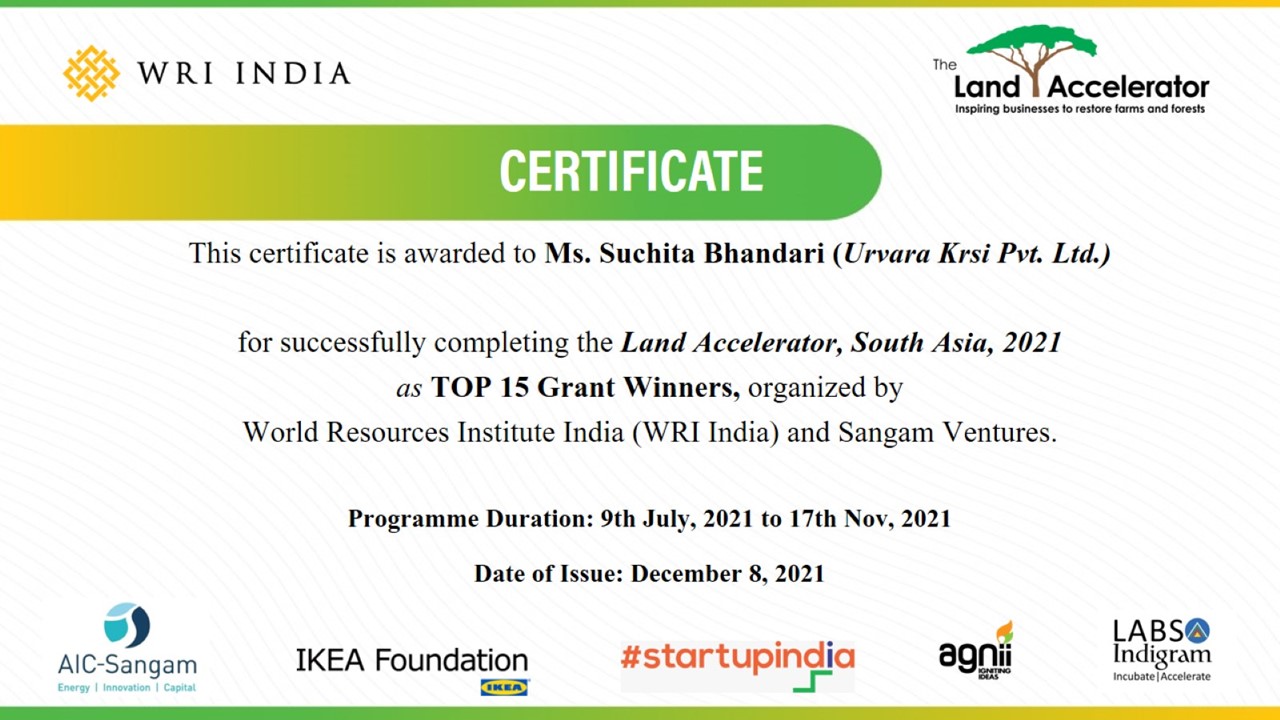
Urvara Krsi was honoured with the Land Accelerator South Asia 2021 Award, an initiative by the World Resources Institute India (WRI) in collaboration with Sangam Ventures and funded by the IKEA Foundation. This Accelerator is part of WRI’s Global Restoration Initiative, aiming to develop sustainable and profitable business models for land restoration.

Urvara Krsi promotes sustainable, environmentally friendly practices by integrating quality germplasm availability and raising productive forest plantations on less-productive farmlands with farmers.